
About
The consortium

The consortium
A European alliance for urban innovation
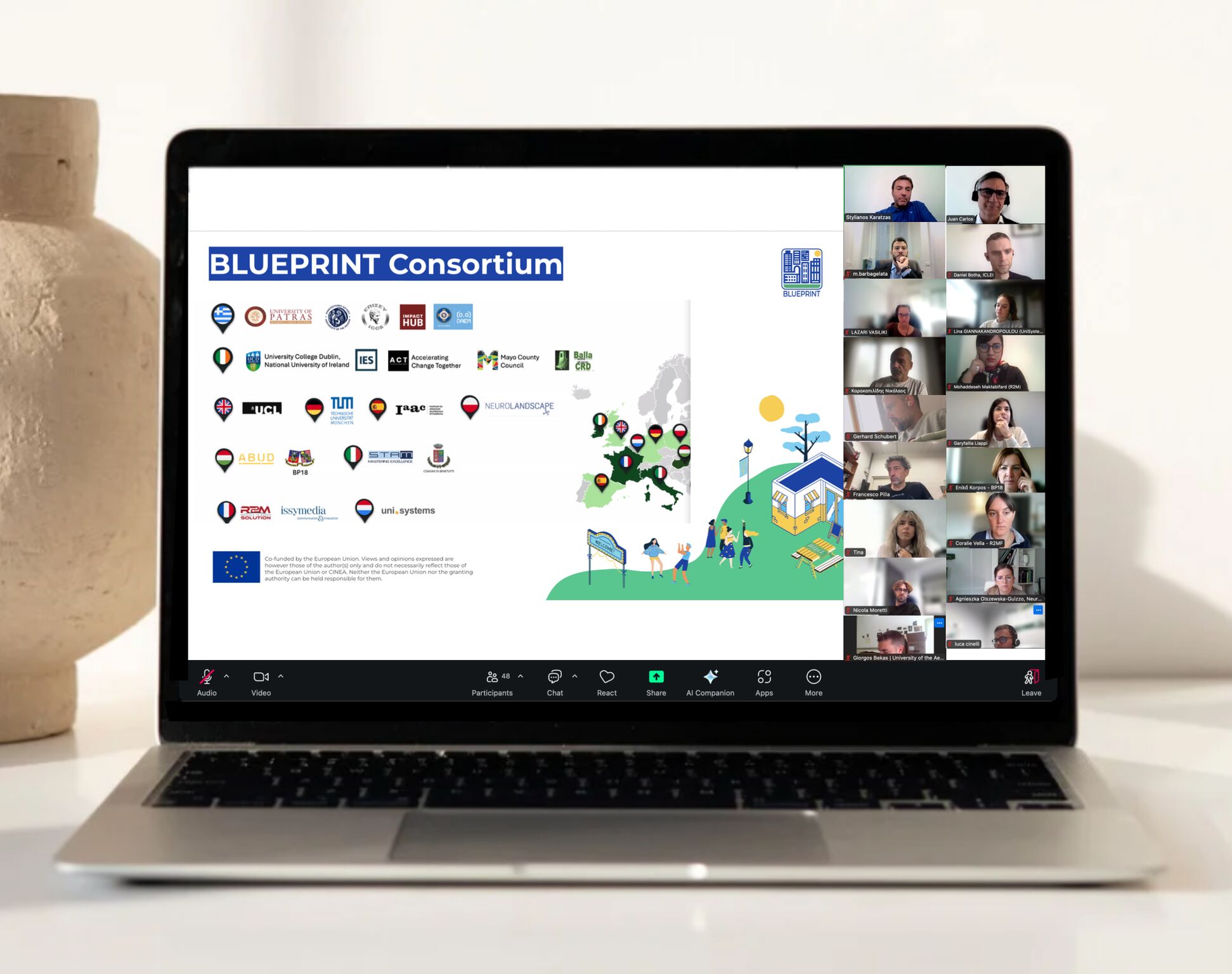
The BLUEPRINT consortium is coordinated by the University of Patras (UPAT) and brings together 23 partners from 10 European countries (Greece, United Kingdom, Germany, Ireland, Spain, Poland, Hungary, France, Luxembourg, and Italy).
Our strength lies in our diversity: we unite leading academic institutions, technical innovators, and forward-thinking municipalities to solve complex urban challenges.
This multidisciplinary partnership unites five major universities (UPAT, UCL, TUM, UCD, and the University of the Aegean), alongside leading research institutes such as IAAC and ICCS, which provide the essential academic and technical framework.
Complementing this scientific foundation, the consortium integrates a strong technological and entrepreneurial component with ten SMEs specializing in climate technology, sustainability consultancy, ICT infrastructure, and engineering, including IES, ABUD, R2M Solution, UNIS, and STAM.
Local implementation and citizen engagement are driven by public bodies and local authorities, notably the Municipality of Budapest (District 18), the Municipality of Benetutti, Mayo County Council, and the City of Athens IT Company (DAEM), supported by local entities like SEM Issy Media and non-profit organizations such as NeuroLandscape and ICLEI Europe.
This alliance thus covers the entire value chain necessary for sustainable urban regeneration, ranging from theoretical design and the development of advanced digital tools (Digital Twins, AI, Augmented Reality) to their concrete deployment and social validation across the project’s five pilot sites in Athens, Balla, Benetutti, Budapest, and Issy-les-Moulineaux.
Our partners
🔬 Research & Academia
Leading the theoretical and scientific framework of the project.

University of Patras (UPAT) 🇬🇷
As Project Coordinator, the University of Patras leads the BLUEPRINT consortium, driving overall management and quality assurance. UPAT champions a socio-technical approach, integrating Digital Twins and AI with participatory modelling to translate community values into climate-neutral renovation scenarios. Additionally, UPAT oversees the project’s scalability assessment, ensuring these innovative solutions are adaptable and replicable for municipalities across Europe.

University College London (UCL) 🇬🇧
Based in London, UCL contributes its world-leading expertise through The Bartlett School of Sustainable Construction. In BLUEPRINT, they lead the development of the system architecture and data integration strategies essential for urban performance analytics. UCL focuses on bridging technical data with user feedback through the GeoBIM Crowdsourced asset condition assessment tool, ensuring that building maintenance is driven by both engineering metrics and stakeholder needs.

Technical University of Munich (TUM) 🇩🇪
As a leading European research university, TUM brings world-class expertise in engineering and design to BLUEPRINT. Through its Department of Architecture, TUM contributes specialized knowledge in gamified collaborative design tools to enhance stakeholder engagement. Within the consortium, TUM is responsible for delivering innovative prototypes and ensuring their seamless integration into the overall digital system, bridging the gap between architectural design and advanced participatory technologies.

University College Dublin (NUID UCD) 🇮🇪
As Ireland’s largest university, UCD brings cutting-edge expertise in Artificial Intelligence and Machine Learning to the consortium. In BLUEPRINT, they are responsible for developing intelligent data analytics and recommender engines. These AI-driven tools process complex urban data to suggest optimized renovation scenarios, helping stakeholders understand the trade-offs between energy performance, cost, and social impact in real-time.

Institute for Advanced Architecture of Catalonia (IAAC) 🇪🇸
Based in Barcelona, the IAAC is a center for research, education, and innovation dedicated to shaping the future of the built environment. In BLUEPRINT, IAAC leverages its expertise in emerging technologies to lead the Participatory Scenario Design. They focus on developing advanced digital tools for participatory urbanism, bridging the gap between radical research and real-world applications to transform cities and public spaces.

University of the Aegean (AEGEAN) 🇬🇷
Based in Syros, Greece, AEGEAN contributes its expertise in product and systems design engineering. Leading the Methodological Frameworks, AEGEAN develops the co-design and assessment strategies central to the project. They bridge the gap between technical innovation and community engagement, ensuring that digital tools (such as AI and Digital Twins) effectively empower citizens and stakeholders to shape inclusive, sustainable urban renovations across all pilot sites.
🛠️ Technology & Innovation
Developing the digital tools and platforms.

IES & IES R&D 🇬🇧
With headquarters in Glasgow and a strong R&D division in Ireland, IES is a global leader in performance analysis software. They provide the core Digital Twin technology for BLUEPRINT. Using their Intelligent Communities Lifecycle (ICL) platform, IES creates physics-based 3D models of the pilot sites to simulate energy flows and carbon emissions, ensuring that the proposed renovation scenarios are technically rigorous and environmentally measurable.

NeuroLandscape (NL) 🇵🇱
Based in Warsaw, NeuroLandscape brings unique expertise in neuroscience and environmental psychology to BLUEPRINT. Focusing on quantifying wellbeing, they integrate neuroscience-informed methodologies into the design process. NL develops the Contemplative Landscape Automated Scoring System (CLASS) to assess the restorative potential of urban spaces and conducts mobile EEG studies to measure citizens’ physiological responses to renovation scenarios.

Advanced Building & Urban Design (ABUD) 🇭🇺
Based in Budapest, ABUD is a sustainability design consultancy specializing in resilient built environments. Leading the pilot condition assessments, they coordinate real-life urban projects and serve as the technical partner for the Budapest pilot. ABUD leverages data-driven simulations to co-develop digital tools, including micro-climate analytics and the “Songlines” tool, ensuring solutions align with local stakeholder needs.
R2M Solution France 🇫🇷
Based in Roquefort-les-Pins, R2M Solution is an integrated research and advisory company specializing in innovation management. In BLUEPRINT, they focus on the exploitation and business modelling of the project’s solutions. They ensure that the technical and social innovations developed are financially viable and marketable, paving the way for widespread replication of the BLUEPRINT model across other European municipalities.

I-SENSEGroup / ICCS 🇬🇷
Represented by the I-SENSE Group, ICCS brings extensive expertise in virtual environments and smart integrated systems. In BLUEPRINT, they lead the definition of technical specifications for digital tools and the development of immersive AR/VR environments. ICCS ensures stakeholders can actively explore and co-design renovation strategies through intuitive, high-fidelity visualizations, bridging the gap between complex data and user engagement.
STAM 🇮🇹
Based in Genoa, STAM is an engineering consultancy bridging research and industrial deployment. Leading the Digital Tools co-design and development, they provide the project’s central digital toolset. STAM leverages Digital Twins and BIM to create the Immersive Scenario Validator Tool (ISVT), translating complex renovation strategies into tangible scenarios that facilitate transparent, evidence-based dialogue among stakeholders.

Uni Systems (UNIS) 🇱🇺
Based in Luxembourg, Uni Systems is a leading European ICT solutions provider. In BLUEPRINT, they leverage their expertise in complex ICT infrastructures to lead the BLUEPRINT Platform. UNIS is responsible for project data management and the seamless integration of all digital tools and Digital Twins into a secure, scalable, and user-centric environment.
🏛️ Cities & local implementation
Deploying solutions on the ground and engaging with citizens.
ICLEI European Secretariat 🇩🇪
Based in Freiburg, Germany, ICLEI Europe connects a vast network of local governments to drive sustainability. In BLUEPRINT, they lead the training, replication, and scaling of project results. ICLEI facilitates the “Curiosity Network” and learning accelerators to exchange knowledge between cities. Furthermore, they are responsible for consolidating learnings into an actionable New European Bauhaus toolbox, ensuring widespread adoption of participatory renovation practices.
Accelerating Change Together (ACT) 🇮🇪
Based in Ireland, ACT is a social enterprise of architects and urbanists dedicated to accelerating the green transition. In BLUEPRINT, they leverage their expertise in co-design to facilitate meaningful stakeholder engagement. ACT leads the delivery of participatory workshops, helping to make complex digital tools and renovation scenarios accessible to non-experts. Their role ensures that local voices and social knowledge are effectively integrated into the project’s urban planning processes.
Impact Hub
Part of a global network for social innovation, Impact Hub Athens acts as the engagement partner for the Greek pilot site. Working alongside DAEM, they design and facilitate inclusive participatory processes. Their role is to mobilize the local ecosystem (citizens, creatives, and entrepreneurs …) ensuring that the digital tools and renovation plans effectively address the real social and economic needs of the Kypseli neighborhood.
City of Athens IT Company (DAEM) 🇬🇷
As the long-standing IT company for the City of Athens, DAEM leads the Greek pilot site. Leveraging decades of experience in e-Governance, they coordinate local implementation in collaboration with Impact Hub Athens. DAEM utilizes its extensive network of decision-makers and citizens to deploy and validate BLUEPRINT’s digital solutions, ensuring they effectively support the city’s operational standards and urban renovation goals.
Issy Média 🇫🇷
Based in Issy-les-Moulineaux, France, Issy Média is a Local Public Company driving the city’s communication and digital innovation. In BLUEPRINT, they lead the French pilot site, coordinating the adaptive reuse of office buildings into residential spaces. They facilitate local stakeholder engagement to co-design these renovations, directly supporting the city’s ambition to become climate-neutral.

Municipality of Budapest - District 18 (BP18) 🇭🇺
Located on the outskirts of the Hungarian capital, BP18 leads the Hungarian pilot site. Focusing on youth-centric urban transformation, they coordinate the adaptive reuse of the Pálma building and the revitalization of Üllői Road . Leveraging strong local networks with citizens and cultural institutions, BP18 facilitates participatory workshops to test BLUEPRINT’s digital tools, driving climate resilience and energy efficiency standards in a suburban context .
Comune di Benetutti 🇮🇹
Located in Sardinia, the Municipality of Benetutti serves as the Italian pilot site. This rural municipality focuses on leveraging digital tools to modernize its infrastructure while preserving its authentic cultural heritage. They coordinate local testing activities, engaging residents to validate how advanced renovation technologies and participatory governance can be successfully adapted to small-scale, historical urban environments.

Mayo County Council (MCC) 🇮🇪
As the local authority for the region, Mayo County Council supports the Irish pilot site in Balla. They provide crucial institutional backing, policy alignment, and technical planning expertise. MCC works to bridge the gap between bottom-up community initiatives and formal planning procedures, ensuring that the participatory renovation models developed in Balla can be integrated into wider regional development strategies and replicated county-wide.
Balla Community Centre (Balla CRD) 🇮🇪
Based in Ireland, Balla CRD is a community-led organization dedicated to generating enterprise for local welfare. As the Irish pilot site representative, they are pivotal in mobilizing the community. By leveraging strong connections with local groups, businesses, and schools, Balla CRD facilitates widespread engagement, organizing community clinics and workshops to ensure citizens actively participate in the town’s urban renovation planning.